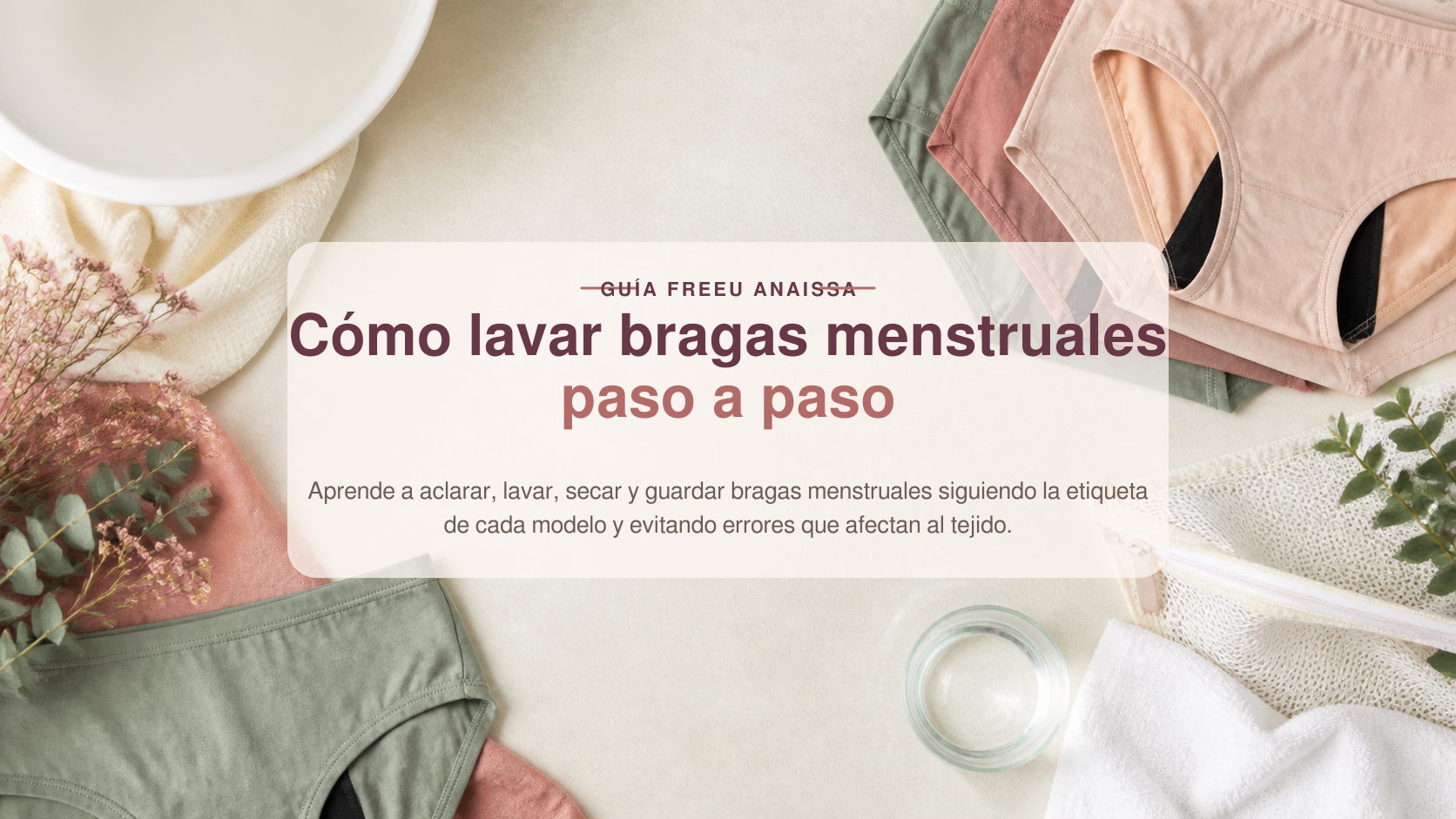

Washing a menstrual underwear item should not become a universal trick list. It is a technical garment and each model may combine different fabrics, layers, and finishes. The primary reference is always the label or the current product sheet. From there, you can organize a simple routine to rinse, wash, dry, and store the garment without improvising.
This guide starts from the instructions that appear on the current FreeU Anaissa menstrual garments product sheets consulted on August 18, 2026. Several sheets agree on rinsing with cold water, using a neutral detergent, avoiding bleach and fabric softener, and air-drying. If your label indicates something different, follow the specific instruction for that garment. The aim is not to promise a specific duration, but to help you care properly for what you already have and understand the routine before buying.
Quick answer
After wearing the garment, check its label. In the FreeU Anaissa models consulted, the common guideline is to rinse with cold water, wash by hand or in the washing machine with a neutral detergent, do not use bleach or fabric softener, and air-dry. Do not copy temperatures, cycles, or products from another garment if they do not appear in your model's instructions.
See menstrual underwearKey points
- The model label governs over any general internet advice.
- Rinse with cold water when the sheet indicates so and avoid twisting the technical layers hard.
- Use the detergent and wash type allowed by the manufacturer; do not add products by intuition.
- Bleach and fabric softener appear as not recommended in the Anaissa menstrual sheets reviewed.
- Air-dry when the garment's instruction requires it and store it only when completely dry.
- Organize enough replacement items so that washing and drying time does not force you to reuse a damp garment.
Who this guide is for
- Someone who just bought their first menstrual underwear and wants to understand the basic routine before first use.
- Someone who already uses reusable garments but mixes instructions from different models and needs a clearer method.
- Families preparing a simple routine for teenagers and want to separate real instructions from viral tips.
- People comparing garments and want to consider washing and drying as part of the purchase decision.
When it may not fit
- If you are looking for a single temperature, a fixed soaking time, or a universal recipe for any fabric: those data should be checked on each label.
- If the garment shows damage, a persistent odor, or a behavior change that is not resolved by following its instructions: consult the manufacturer before trying aggressive treatments.
- If you have irritation or discomfort: stop using the garment and seek professional guidance when appropriate; washing the garment is not a health assessment.
What you should know
A menstrual underwear item brings together several parts with different functions: the outer fabric, the body-facing area, the inner layers, and the elastics or seams that keep the fit. Therefore, care should not be decided solely by appearance. A washing product or a heat source can be compatible with one garment and not recommended for another.
The current sheets for several FreeU Anaissa models share four easy-to-recognize instructions: rinse with cold water, hand wash or machine wash with neutral detergent, no bleach or fabric softener, and air-dry. That coincidence allows for a starting routine, but does not authorize adding a temperature, a cycle duration, a soaking time, or a drying method that the specific sheet does not declare. Some models may include additional instructions.
It is also useful to separate cleaning from performance. If a garment changes with use, it is not correct to automatically conclude that it is washed badly. First check whether you followed the label, whether you changed detergent or program, and whether the fabric, seams, or elastics show wear. Then consult the sheet or the brand's customer service. This order avoids home remedies that can complicate the problem.
Organization matters as much as washing. A reusable garment needs to complete its cycle of use, cleaning, and drying before returning to the drawer. If your daily routine does not allow that margin, plan replacements. The right quantity depends on how many days you use them, how often you wash, and the actual drying time in your home; there is no single figure that fits everyone.
Washing routine in six steps
Read the label before the first wash
Find the specific garment’s instructions and keep the product sheet if the label uses symbols you do not recognize. Check the allowed wash type, the products to avoid, and the drying method. Do not assume that two models from the same brand have exactly the same composition.
Separate the used garment without leaving it forgotten
When you change outside home, store the garment in a contained way until you can follow its care routine. On arrival, avoid leaving it in a closed bag for several days. If the sheet indicates rinsing, do it as part of the routine and without turning it into an invented soaking duration.
Rinse with cold water if the model indicates it
Let the water flow and press gently. You do not need to twist strongly or brush the technical area. The goal is to follow the product’s guidance, not subject the fabric to an additional treatment. If the label does not indicate rinsing or contains a different instruction, respect it.
Choose hand wash or machine wash according to the sheet
The Anaissa models reviewed allow hand washing or machine washing with neutral detergent, but you must check yours. If you use a washing machine, apply the program permitted by its label. Do not add a specific temperature because you saw it on another website or another garment.
Avoid products expressly excluded
The sheets consulted indicate not to use bleach or fabric softener. Maintain that rule for those models and do not substitute those products with homemade mixes. If you need to resolve a stain or odor, ask the manufacturer which option is compatible before experimenting.
Dry and store with patience
When the sheet indicates air drying, place the garment so it can ventilate and wait until it is completely dry before storing. Do not speed up the process with an unauthorized heat source. A clean, dry drawer completes the routine until the next use.
Limits and checks
- Do not mix instructions from different products: keep the model reference for each garment.
- Do not attribute health properties to a detergent or fabric that the product documentation does not demonstrate.
- Do not use bleach, fabric softener, dryer, direct heat, or home remedies when the label excludes them or does not contemplate them.
- If the garment is damaged, check seams, elastics, and the technical area before using it again and consult the manufacturer if in doubt.
- If irritation, pain, or another discomfort appears, stop using the garment. Textile care does not diagnose or treat health problems.
How to choose
Before buying, compare the declared care routine with the time and resources you have at home.
| Option | Best fit | Consider |
|---|---|---|
| Hand wash | Your sheet allows it and you can dedicate a few minutes to handle the garment gently. | Requires consistency and a practical space for rinsing and drying; do not improvise products or times. |
| Machine washing | The model supports it and you can select the program and detergent indicated on its label. | You must check the model conditions; that a garment supports machine washing does not make any cycle appropriate. |
| Air drying | You have ventilation and enough time before the next use. | Drying can determine how many replacements you need, especially if you wash infrequently. |
| Rotation of multiple garments | You want to cover several days without depending on a single garment finishing drying. | The initial purchase is higher; calculate rotation from your actual routine and not a standard figure. |
Related products
Related products help compare formats and consult their current sheets. Before choosing, open each product and review composition, size, availability, and washing instructions. The article does not assume that all garments support the same program or recommend buying a model simply because it appears on this page.
 Real product for this decision
Braga Menstrual de Bambú con Cierre de Velcro Velcrochip
27,95 EURSee menstrual underwear Real product for this decision
Pack 2 Short Menstrual TEEN de Bambú – Flujo Abundante Mayder
50,00 EURSee menstrual underwear Real product for this decision
2 tangas menstruales fabricadas en bambú Weekly
50,00 EURSee menstrual thong Real product for this decision
Braga menstrual Extra Absorbente de algodón flujo abundante Laia
27,95 EURSee menstrual underwear Real product for this decision
Braga Menstrual Extra Absorbente para Flujo Muy Abundante | Mer
27,95 EURSee menstrual underwearUse and care
- Keep the label or a copy of the sheet so you do not depend on memory.
- Rinse with cold water when that is the specific instruction for the product.
- Use neutral detergent and the wash type allowed by the garment.
- Do not use bleach or fabric softener on Anaissa models whose sheets exclude them.
- Air dry when the label indicates and store the garment completely dry.
- Review the instructions again if you change model, fabric, or format.
Frequently asked questions
Do menstrual underwear need to be rinsed before washing?
Do it when the sheet or label indicates it. The FreeU Anaissa models reviewed include rinsing with cold water, but a general guide should not replace your specific garment’s instruction.
Can menstrual underwear be washed in a washing machine?
Some reviewed Anaissa models allow hand washing or machine washing with neutral detergent. Check the symbol and the permitted program on your label before starting the cycle.
Can I use fabric softener or bleach?
The consulted Anaissa sheets indicate not to use bleach or fabric softener. Follow your model’s instruction and avoid substituting them with unapproved homemade mixes.
Can I use a dryer?
Do not use it if the label indicates air drying or excludes the dryer. If instructions are unclear, contact the manufacturer rather than applying heat by trial and error.
What do I do if a garment retains a stain or odor?
First check that you followed its sheet. Do not apply bleach, stain removers, or homemade remedies without confirming they are compatible. Contact the brand and provide the model and routine used.
How many garments do I need to wash and dry them?
Depends on how many days you wear them, how often you wash, and how long drying takes in your home. Note those three data and add practical replacement margin; you do not need to accept a universal figure.
Next step
A reliable routine begins with a very unglamorous action: reading the label. From there, rinse, wash, dry, and store according to the model. The reviewed Anaissa sheets share a clear base — cold water for rinsing, neutral soap, absence of bleach and fabric softener, and air-drying — but each new garment must be checked separately. Organize replacements around your washing frequency and the real drying time. This way the content helps you use the garment better without turning a general recommendation into a promise or an invented instruction.